

Policy and strategy
Antimicrobial resistance (AMR) is a complex public health concern necessitating the involvement of diverse stakeholders across sectors and levels of organization and governance. National, regional and global policies should address the complex factors driving AMR, and be based on public health principles such as surveillance, prevention, containment and research.
In May 2026, Member States at the Seventy-ninth World Health Assembly (WHA79) endorsed WHO’s updated “Global action plan on antimicrobial resistance”, marking a major milestone in the global response to AMR and delivering on a key commitment contained in the 2024 United Nations General Assembly “Political Declaration of the High-Level Meeting on Antimicrobial resistance”.
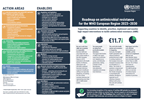
To provide a strategic framework for controlling AMR in the WHO European Region, Member States have adopted the “Roadmap on antimicrobial resistance for the WHO European Region 2023–2030”. This identifies 5 action areas and 6 enablers for countries to adapt to their own national contexts. Each action and enabling area contains evidence-based interventions to guide Member States on their priorities and national action on AMR.
WHO/Europe supports the development and review of national action plans on AMR that are aligned with the objectives of the Global action plan and European Roadmap.
Guidance documents
Resource guide for the implementation of the Roadmap on antimicrobial resistance for the WHO European...
The Roadmap on antimicrobial resistance for the WHO European Region 2023–2030supports Member States to identify, prioritize, implement and monitor...