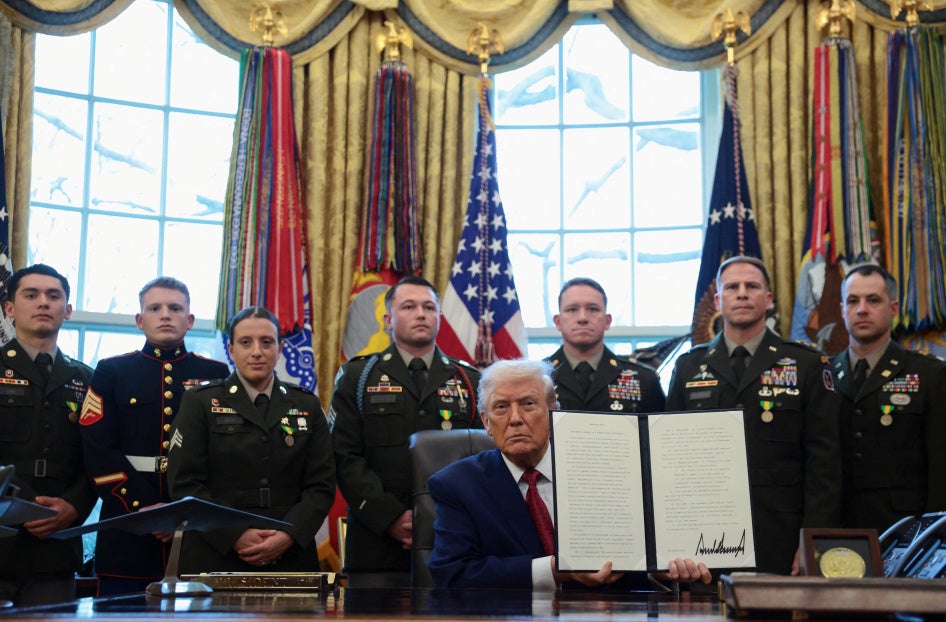
A new executive order seeking to designate “illicit fentanyl” a “weapon of mass destruction” could open the door to a dangerous expansion of militarized law enforcement and abusive military action.
The December 15 order directs the defense secretary and attorney general to “determine whether the threats posed by fentanyl and its impact on the United States” justifies the Defense Department aiding the Justice Department in law enforcement.
The order states that fentanyl has the potential “to be weaponized for concentrated, large-scale terror attacks by organized adversaries.” But domestic and international law already authorize responsive action if fentanyl were employed as a chemical weapon.
This order is particularly worrying amid the Trump administration’s use of drug trafficking as a pretext to justify unlawful military strikes. Since September, the administration has carried out more than two dozen strikes on alleged drug trafficking boats in the Caribbean and Pacific, resulting in at least 99 extrajudicial killings. This context raises the concern that the order aims to facilitate an expansion of such unlawful actions.
The executive order is also dangerous in the current domestic context, following months of National Guard deployments to multiple US cities. While US law enforcement agencies commit many human rights abuses, the involvement of the military in law enforcement would pose additional risks. Military forces bring fundamentally different training and experience to bear, focused less on rights-respecting law enforcement and more on the effective use of lethal force.
While governments have a legitimate interest in working to stop drug trafficking, addressing the harm of unregulated fentanyl requires an emphasis on evidence-based public health interventions. Militarized policing in US communities could unleash serious abuses, especially against Black and other overpoliced communities. US drug policy has historically fueled racially discriminatory policing, arrests, and incarceration. It has not adequately addressed harm caused by drug trafficking, like overdose deaths, which disproportionately affect Black and Indigenous people, who face disparities in health care access.
The administration should channel concern about fentanyl into harm reduction strategies that safeguard rights, rather than calling it a weapon of mass destruction to create the illusion of a threat that warrants military action.